January 12, 2026
Homage to Naomi and June, who passed away last November Network
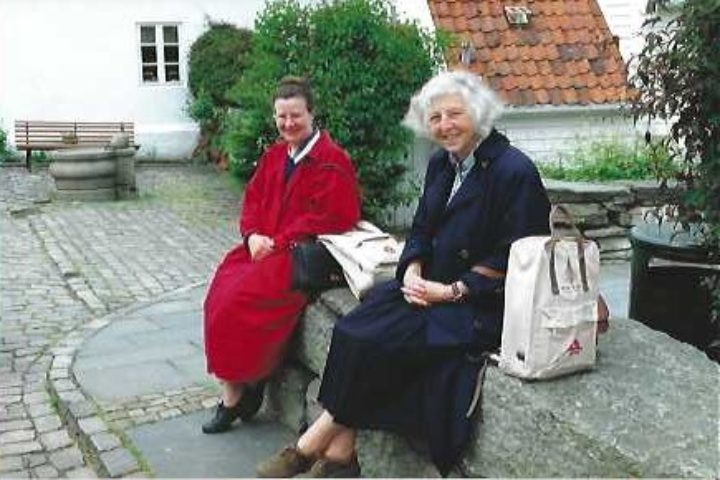
NAOMI TARRANT
By Ann Coleman
Chair of Costume Committee 1989-95
Saying goodbye is difficult, saluting a rich and committed life is more challenging, especially when it is diverse and well lived. I first met Naomi Tarrant in the late 1960s on her first morning on the job at the Royal Scottish Museum, a contemporary working with a similar costume and textile collection. Ah I thought someone to thrash common issues with. Ever practical, inquisitive, and generous Naomi would quietly go on to a landmark career at what is now known as the Museum of Scotland. Her bibliography is long and diverse, practical, and pointed. She was charged with shepherding not only the main museum’s costume collection but also the offsite collection of Charles Stewart at Shamberlie. Having been mentored by one of Scotland’s prime textile historians, Margaret Swain, Naomi mentored generations of colleagues around the planet. She spread her knowledge, wit, and wisdom through her associations, her landmark fifty years plus association with the ICOM Costume Committee, the British Costume Society, the Costume Society of America, and CIETA to name a few professional costume and textile focused organizations. For many decades Naomi’s searches for greater understanding of both textiles and apparel took her and myself, as a tourist, to explore little explored parts of the planet. To satisfy her “eye” she collected both modern Scottish glass and jewellery. In her closing decades she turned her attention to schoolgirl needlework to better utilize her interest in genealogy. She leaves no immediate family, just a bounty of friends and professional accomplishments.
If you want to read her last book ‘Remember Now Thy Creator’ Scottish Girls’ Samplers, 1700–1872 from Naomi E A Tarrant,
please click here.
JUNE SWANN: June 3, 1929 – November 21, 2025
By Cathy Newman
Former Editor at Large, National Geographic
“Shoes are the best indicator of how people are feeling,” June Swann, who died at the age of 96 on November 21 in Northampton, England, told me when we met in 2005. She meant you could measure prosperity by the height of a heel, social change by the thickness of a sole and more. She would know. As one of the world’s most eminent shoe historians, she worked for 38 years as Keeper of Shoes at the Northampton Museum in the city that once supplied shoes to the world.
She was 76-years-old, when I met her. I’d successfully pitched my editors at National Geographic to let me do a story on shoes that ran in the September 2006 issue of the magazine. “You must go see June Swann,” my friend Ann Coleman, then curator of Textiles and Fashion Arts at MFA, Boston, insisted. “She’s the foremost authority on European shoes.”
She was slight of build with a triangular wedge of white hair and wore size 6 Ecco sandals. She had by then retired as Keeper of Shoes, a title she regarded with skepticism. “’Keeper’ makes me sound like I take care of animals,” she said tartly. She was opinionated, ferocious, and rigorously disciplined about scholarship. Even in retirement she still carried a plastic shopping bag with a magnifying glass, a tape measure, scraps of paper pinned together to serve as a pad, and a flashlight in case she encountered any shoes needing examination. Hands on examination was how she learned. She was largely self-taught. (“Too much of the literature is unreliable,” she said.)
She didn’t read books for plot. She read them for shoes. Madame Bovary made a pair of slippers for her lover. Jane Austen’s Emma deliberately broke a shoe lace as a ruse to attract a man. She read Boccaccio’s Decameron because a 15th century Italian painting depicting one of the tales shows courtiers wearing poulaines, a medieval shoe. In a film version of Pride and Prejudice starring Judi Dench, she noted with disapproval an Edwardian boot peeking out from an 18th century gown. In her home, she had 30 feet of files on shoes arranged by date, country, continent and ‘wild card’ entries, like one marked ‘polish,’ with the notation that Princess Diana’s step-mother wore blue Meltonian shoe polish as eyeliner when big eyeliner and mascara was in vogue.
She practically spoke in aphorisms: “Never underestimate a woman in high heels,” –-though she confessed she hadn’t worn a pair of heels since 1959––and “athletic shoes show how tolerant of ugliness we are” (flip flops, she opined were only one step better.)
Then there was the museum guard who presented her with a black plastic garbage bag left in front of the museum that held a collection of fetish shoes. Of course, they were added to the collection, though her bosses could hardly get the word “fetish” out.
She was born in Northampton. Her father was a newspaper distributor; her mother worked as a secretary in a shoe factory. After university she started as a junior assistant at the museum as a temporary measure until she could find something better. She ended up staying 38 years. It was, she claimed, the largest collection of historic shoes in the country when she started, and largest in the world when she left. Museums around the world hired her to catalog their collections and she was awarded an MBE by Queen Elizabeth in 1976 as Keeper of the Boot & Shoe Collection, Northampton Museum. She kept the medal in a dresser drawer.
In 1958, someone bought her a pair of 19th century child’s boots they’d found in a thatched roof. “I worried about that pair of shoes for a long time,” she said. “What parent would let a child play on a thatched roof?” When a colleague mentioned someone had brought him an old shoe found beneath floorboards, the light clicked on. Swann realized the shoes were placed there intentionally; she started a registry of concealed shoes and published on the subject. But she never reached a definitive conclusion that explained the practice. Her rigorous scholarship would never allow that liberty.
It was one of the very few things she had no answer for.